In 1992, a gardening friend sent me a magazine article about the restoration of
Thomas Jefferson's vegetable garden at Monticello which totally focused my work for many years afterward.
If you don't know this garden, you might be interested to hear that Thomas Jefferson, in addition to being the principal author of the Declaration of Independence and our nation's third president, was an avid gardener and researched and wrote extensively about farming and gardening as an American activity. He used his vegetable gardens for research, growing, for example, fifteen different varieties of the English pea, his favorite vegetable.
The vegetable garden itself lay across the flat top of Monticello mountain in long ribbon -- 80 feet by 1000 feet -- patterned with row after horizontal row of varying vegetables, up to 80 varieties of vegetables, herbs, and edible flowers per season. In, I might add, the extraordinarily beautiful landscape of the mountains of Charlottesville, Virginia.
I am not much of a historian: That's just about enough of the story for me, right there. As an artist, I was thrilled by the visual, by what I saw as a textile opportunity in the ribbon and the pattern, by the simpler story of a learned man who loved, above all, to grow vegetables, and so off I went! I visited the garden as soon as I could get there, sketchbook and camera in hand, and was soon interviewing the gardeners, being taken to the head of the gardens -- a scholar and plantsman named
Peter Hatch -- and shown the greenhouses, the tool sheds, anything I wanted to see.
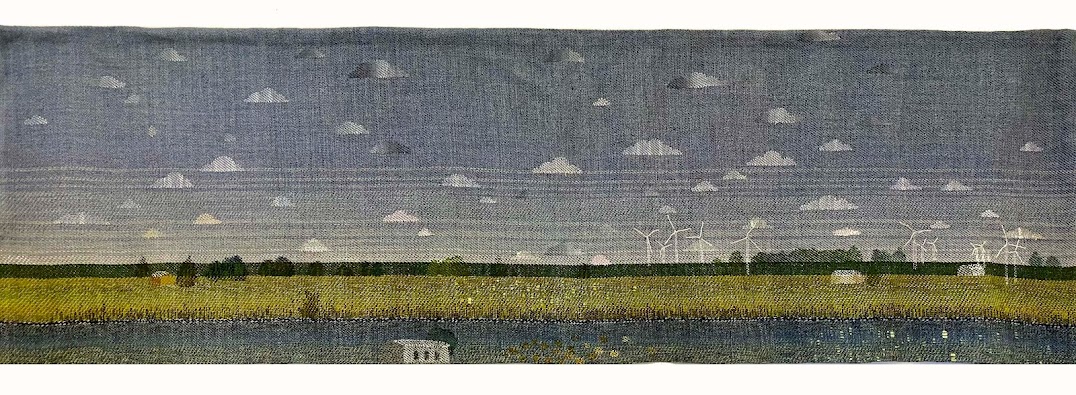
I wove a set of tapestries about that garden which I named the Thousand Foot Garden. The centerpiece was a set of 68 different woven panels of most of the vegetables growing there during the season in which I visited -- they had kindly shared their planting diagrams for summer 1992. I also made an elevation of the garden, a bird's eye view plan, and a number of pieces describing the potting sheds, the tools, etc -- in other words, the process of making the garden.
This particular piece, Harvest 1992, proved a seminal piece of work for me. It involved researching and drawing many differnet varieties of plants, but more importantly, figuring out how to weave things like santolina, or lavender. The root vegetables were straightforward by comparison, but I had developed a rationale for how I would "draw", row by row on the loom, and had to figure out how to incorporate all of these new types of form in my woven language.
Eventually when I began my ribbon business, for which this blog is named, one of the first few ribbons I designed was
vegetables. Given the expense of designing very long repeats (the economy of weaving my ribbons was in the length of the repeat, if you can believe it, as I was charged for the number of repetitions of the design unit. If it was a 9" repeat, it would be much more expensive to purchase 5000 repeats of that than if it were a 2" repeat, where I might be ordering 15,000 repeats --do the math on that to convert it to yardage! Hence I had to choose a very few vegetables to represent it all). I would have loved to make the ribbon with a 160" repeat -- it is possible but has anyone done it? That is why I call my company
LFN Textiles: Artist's Ribbons, because the artist in me is drawn to challenges like this!
This was - and still is - a popular ribbon, and I was able to convince the small gift shop at Monticello to begin carrying such a peculiarly un-touristy item as ribbon, because of it s strong relationship to the place.
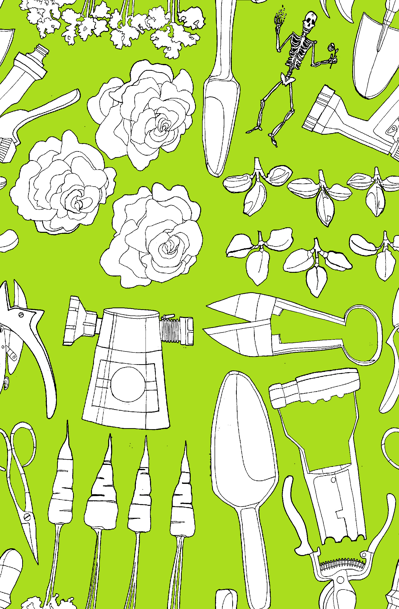
A number of years later, in the recent past, Monticello built a grand new Visitor's center farther down the mountain, which has a good cafe, theater, museum and a vastly improved shop. Since I had been licensing my designs for a few years to Crate & Barrel, and they had loved the vegetable motifs, I persuaded the buyer to license a fresh version of the design - in fact, the design which forms the header of this blog! -- for use on products, to bring a fresh look at the history. And the new products are now available in their spring
catalogue, as well as in the shop in Charlottesville. Naturally, they went on table ware!
And of course, here is the new version of the design as a
ribbon!